Our OnTime Delivery monitoring service has been measuring the delivery of Web pages for over two years now. Before we measured actual page delivery, we had supposed there would be much better reception at certain times of the day, and certain days of the week. We looked forward to determining those times, and publishing the results. We were surprised to find the day to day and hour to hour variations were minimal. The delivery time for any individual page could vary by 200% or more, but the total delivery time for a run of several hundred pages typically varied by only plus or minus 10%. If you are surfing a random collection of pages, there is no "best time" to surf the Web.
We were curious if this flat response across the Web as a whole was reflected in individual servers. Below are the hour by hour response of some of the major sites that we monitor. These measurements were taken in April 97. The red line represents the average for all the servers that we monitor. Apart from the two hour period around 1am PST, there is almost no variation in delivery performance.
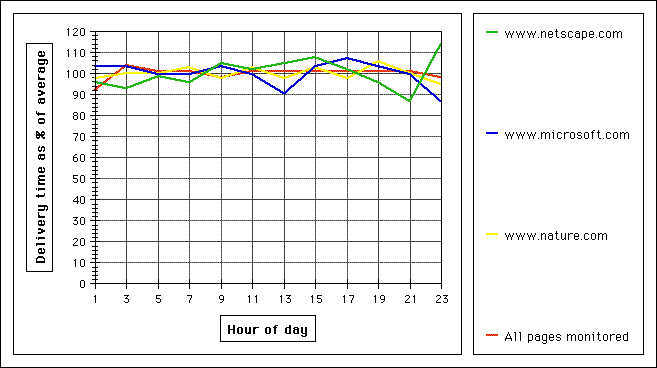
Looking at individual servers however, there are variations of 10% or more in delivery times. Nature, the Science Journal, shows little variation. For Netscape and Microsoft, the variation is larger. Microsoft shows better performance around 11pm PST, but Netscape is noticeably worse. We might expect 11pm to be a low load period, leading to a good delivery time, but for Netscape this isn't so. We suspect that some large sites reduce server capacity at quiet periods, thus evening out response times. A similar pattern shows at other sites (below)
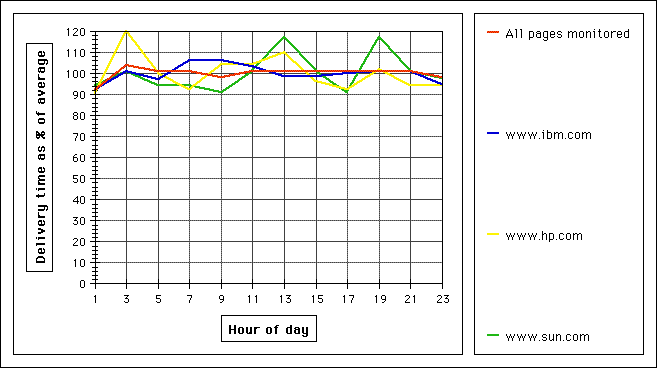
Sun shows a slower deliveries around 1pm and 7pm, while IBM's performance is quite flat at these times. Note that HP has a slower period around 3am, perhaps also indicating a drop in server capacity. Below are some more charts from a study we did in September 96. These show servers hosted by ICL, a major UK system integrator. Times on these charts are Pacific Standard Time, but most of the servers are in the UK, and show slower delivery times during UK office hours.
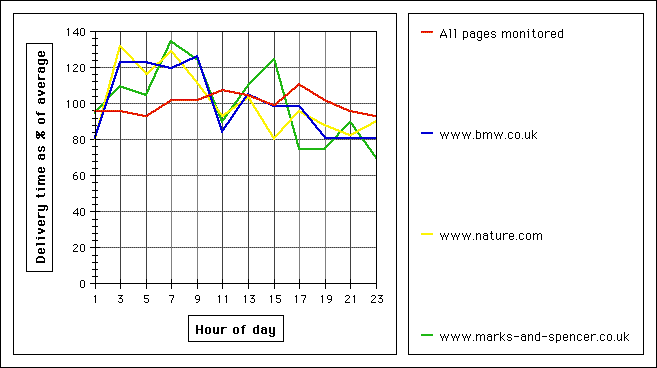
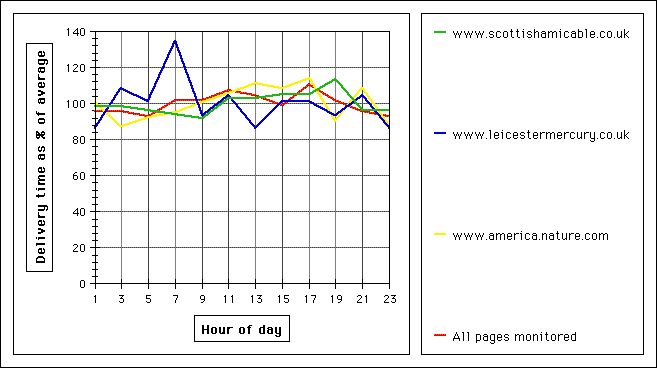
As before, the red line indicates all servers we were monitoring last September. Eight months ago, the average hourly variation was noticeably larger than in our recent study. Things have improved since last year. The one site that occurs in both studies, www.nature.com, has a much flatter hourly response than eight months ago. Because standards are gradually improving, our OnTime Delivery service rates each page delivery relative to the current database. We believe this is better than using a fixed standard. This way, you can be sure your server response is keeping up with rising expectations. (OK, so we had to get in another plug for our service - thatŐs the last one until the end, we promise..)
The ISPs we routinely use for our monitoring aren't causing significant delays. This isn't true of some other ISP's we have measured. And large organizations with "fast pipes" can still show abysmal performance if the local LAN is overloaded. So there may be a local "best time" to surf the net in your organization or your ISP.
Both the receiving and sending ISP will tend to blame "congestion on the Net" for delays, for obvious reasons. Naive users will even accept "net congestion" as an excuse for poor delivery from a local mail server. While congestion certainly exists, we feel it is currently overrated. Our "Great Web Race" survey last year showed that the best servers had a delivery variability of a third or a quarter of the average for all servers. This means that delays at average web site were two or three times those attributable to delays later in the chain, on the Net backbones or our local ISP.
We have gathered all the links in this final section, rather than interrupt the flow of the text above. To see our original analysis of delivery variation, two years ago, see Daily and Hourly Variation from the OnTime Delivery Beta Test report. We were looking for the "best time to surf the Net", and didn't find it. We were surprised by this result. So much so that we sought confirmation of our analysis by a statistics expert. An independent analysis by Prof. J. Hobcraft, Professor of Population Studies at the London School of Economics, confirmed our results. Our 1996 report on the Great Web Race contains some more details on server variation as well as an earlier comment on Daily Variation.
Subscribe to OnTime Delivery!
Last updated 27th October 97 by td@timedancer.com.